
The Aeons
To understand the Aeons in Gnosticism, you have to stop thinking about "time" and start thinking about layers of reality.
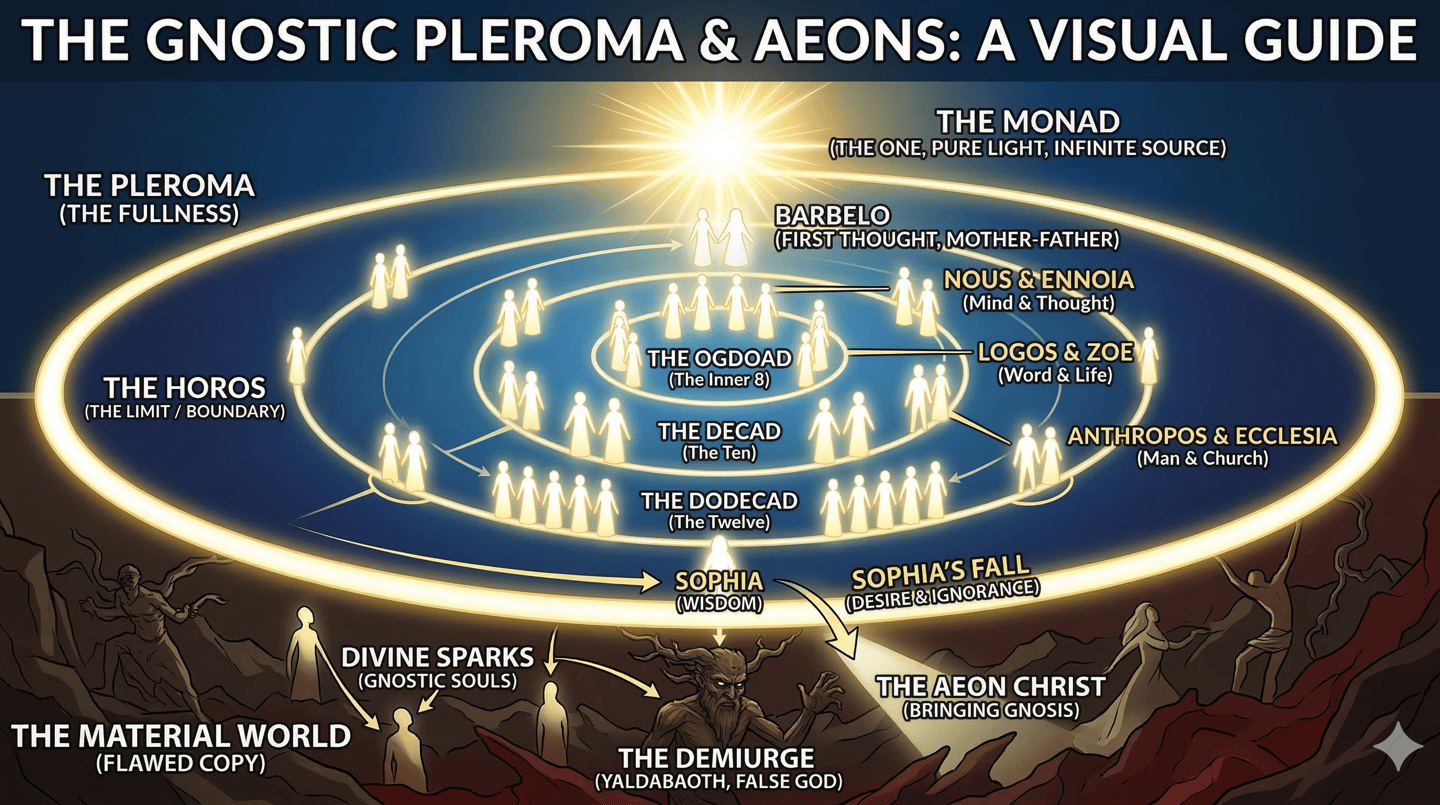
Imagine the universe is a massive, multi-dimensional office building. The "Aeons" aren't the hours on the clock; they are the high-ranking executives, the floors they live on, and the specific "vibes" or concepts they represent. Collectively, these floors and executives make up the Pleroma, which is Greek for "The Fullness."
The Source: The Monad and the First Radiance
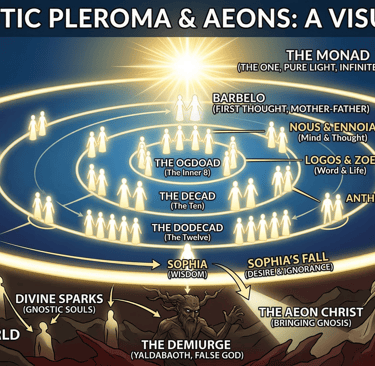
Before there were Aeons, there was only the Monad. Think of the Monad as the "Zero Point" or the "Infinite Sun." It is pure, invisible, and incomprehensible. It doesn’t "do" anything because it already is everything.
However, the Monad didn't want to stay isolated. It began to reflect on itself. This reflection created the first "emanation" or the first Aeon: Barbelo.
Barbelo is often called the Mother-Father or the First Thought.
She is the mirror in which the Monad sees itself.
From this initial spark of self-awareness, a chain reaction began. The Monad and Barbelo produced more "thoughts," and each of these thoughts became a living, divine being, an Aeon.
Her "Partner" is the Monad (The Source)
While most Aeons are created as pairs that balance each other out (like Mind and Thought), Barbelo is the first emanation. She is the direct reflection of the Monad.
The Structure of the Pleroma
The Aeons don't just float around randomly; they exist in a highly organized structure called the Pleroma. If the Monad is the center of the sun, the Aeons are the rays of light. The further a ray gets from the center, the "dimmer" or more complex it becomes.
The Syzygies (The Power Couples)
In Gnostic thought, balance is everything. Almost all Aeons exist in pairs called Syzygies. Each pair consists of a "masculine" principle and a "feminine" principle. This isn't about biological sex; it's about active and receptive forces.
Common pairs include:
Mind (Nous) & Thought (Ennoia): The ability to perceive and the content of what is perceived.
Word (Logos) & Life (Zoe): The expression of truth and the energy that sustains it.
Man (Anthropos) & Church (Ecclesia): The ideal form of humanity and the community of souls.
The Decad and the Dodecad
As the emanations continued, groups of Aeons formed:
The Ogdoad: The first eight primary Aeons (the "Inner Circle").
The Decad: A group of ten Aeons that represent more specific concepts.
The Dodecad: A group of twelve Aeons, bringing the total (in many systems) to 30 Aeons.
Together, these 30 beings represent the "Fullness" of God’s personality. They are the building blocks of the divine realm.
The Nature of an Aeon
What exactly is an Aeon? It’s helpful to think of them as Living Archetypes.
If you feel "Wisdom," you are feeling a tiny fragment of the Aeon Sophia. If you experience "Truth," you are tapping into the Aeon Aletheia. They are not just "people" in the sky; they are the literal, conscious embodiments of those concepts.
Key Characteristics:
Eternity: They exist outside of our timeline. They don't age or die.
Consubstantiality: They are made of the same "divine light" as the Monad, just at different frequencies.
The Boundary (Horos): There is a "limit" or a fence around the Pleroma. This boundary keeps the divine light pure and prevents it from leaking out into the chaos of the "outside" world.
The Crisis: Sophia’s Fall
The most important story in Gnosticism involves the youngest (and furthest from the center) Aeon: Sophia (Wisdom).
Sophia wanted to understand the Monad, the Source, directly. However, the Monad is so bright and intense that looking at it directly is like trying to stare at the sun with a telescope. Because she was the furthest away, she felt a sense of "lack" or "longing."
In her excitement and desire to create something on her own (without her male partner), she produced a "thought" that was out of balance. This thought wasn't a beautiful Aeon; it was a deformed, ignorant being called the Demiurge (also known as Yaldabaoth).
The Result of the Fall:
Exile: Sophia was cast out (or fell out) of the Pleroma.
The Material World: The Demiurge, being ignorant of the Pleroma, thought he was the only God. He used the stolen "divine sparks" from Sophia to create the physical universe, including Earth and our bodies.
Entrapment: This is why Gnostics believe the physical world is a "flawed copy." We are spiritual beings (Aeonic sparks) trapped in material "space suits" (bodies) created by a confused Demiurge.
The Rescue Mission: The Aeon Christ
According to Gnostic myth, the Pleroma didn't just leave Sophia and the trapped sparks behind. A new Aeon was produced to fix the mess: Christ (sometimes paired with the Holy Spirit).
The Aeon Christ descended from the Pleroma, passing through the various layers of the atmosphere (the realms controlled by the Demiurge's henchmen, the Archons) to bring Gnosis (Knowledge) to humanity.
The Goal: To remind us that we aren't just "dust" or "monkeys"; we are actually fragments of the Aeons.
The Escape: By gaining Gnosis, a soul can "climb the ladder" of the Aeons after death, passing the Boundary (Horos) and returning to the "Fullness" of the Pleroma.
Summary: The Big Picture
The Gnostic Aeons are like the Source Code of the universe.
The Monad is the Programmer.
The Aeons are the primary functions and variables of the program.
The Pleroma is the perfect, glitch-free server where the program runs.
Sophia’s Fall was a "bug" that created a partitioned, laggy sub-server (our physical world).
Gnosis is the "cheat code" that allows us to exit the glitchy sub-server and get back to the main system.
info@churchofwambo.org
© SDBEST LLC, 2025. All rights reserved.