

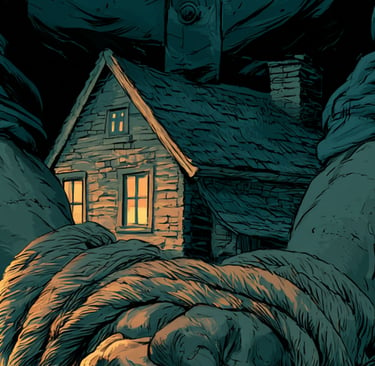
Gospel of Thomas Saying 35: The Parable of Binding the Strong Man Jesus said, "No one can break into the house of the strong and take it by force without tying the hands of the strong. Then they can loot the house."
Inwardly, the "strong man" is the ruler of the false self, ego, conditioned belief, fear, ignorance, attachment to the material world. His house is the psyche under that rule.
AD
7/12/20263 min read

Saying 35: The Parable of Binding the Strong Man
Jesus said, "No one can break into the house of the strong and take it by force without tying the hands of the strong. Then they can loot the house."
A note on the source
This image also appears in Mark 3:27 and Matthew 12:29, inside the Beelzebul controversy, there the "strong man" is explicitly Satan, and it's Jesus doing the binding, in response to an accusation that he casts out demons by demonic power. Thomas strips all of that away. No accusation, no cosmic drama, no exorcism narrative, just the bare image, handed to the reader as something to enact for themselves. That redaction is itself telling: Thomas seems to be deliberately loosening the saying from a one-time salvation-historical event into a repeatable, personal instruction. Everything below follows from taking that loosening seriously.
A Gnostic interpretation
Inwardly, the "strong man" is the ruler of the false self, ego, conditioned belief, fear, ignorance, attachment to the material world. His house is the psyche under that rule.
The saying specifies binding the hands, not the man's existence or identity. Hands grasp; they are the organ of seizing and holding on. So the target isn't annihilating the ego outright, it's disabling its grasping function: compulsive craving, the need to control, the reflex of clinging. That's a more precise claim than simply "dissolving the false self," and a more attainable one.
Who does the binding, though, if the ego is what's running the house? This is the real puzzle in any "still your own mind" teaching, the binder can't simply be identical to the bound, or nothing happens. Gnostic anthropology has an answer: it is not the ego binding itself, but the pneuma, the divine spark already present but dormant, which supplies the leverage once gnosis stirs it, often triggered by an external "call" (cf. Saying 50, "we came from the light"). Three parts, not two: the false ruler, the sleeping owner, and the call that wakes the second against the first.
Once the hands are tied, the house can be looted, and Thomas elsewhere names what's inside it: the treasure of Sayings 76 and 109, hidden and waiting, worth more than the field or the merchant's goods sold to obtain it. The binding isn't the point; it's the precondition for recovering what was already yours.
Two closer parallels than the usual "Kingdom is within you" citations:
Saying 21, the vigilant owner who won't let a thief break into his house, who "gathers his domain and girds his loins" before the thief arrives. Same cluster of house, theft, and vigilance, but the polarity is flipped: there you guard against the thief; here you become the one who breaks in. Read together, they describe one teaching about ownership seen from both sides, sometimes you are defending the house, sometimes you are the one who must storm it.
Saying 98, the man who wants to kill someone powerful and first tests his strength by driving his sword into a wall. Closer in structure to 35 than the usual cross-references: both are about testing or disabling a superior force before acting, not merely inner realization in the abstract.
A psychological reading
Even outside religious language, the saying holds. Take someone trying to overcome an addiction, a phobia, or a destructive habit. The "strong man" is the pattern that protects itself, often precisely by making itself invisible or by reframing its own grip as identity ("this is just who I am"). Attacking the behavior directly, without first disabling the grasping mechanism underneath it, tends to fail; the house is still guarded. Lasting change requires getting at the root defense before the surface behavior will move.
A mystical reading
Here the "strong man" is the illusion of a separate, self-owning self. As long as something in you insists "this is my house," deeper reality stays out of reach. Through contemplative stillness or awakening, the grasping hand loosens its hold, not necessarily erasing the self, but breaking its exclusive claim of ownership. What surfaces afterward is what many traditions call union with the divine, or simply direct awareness unmediated by that claim.
info@churchofwambo.org
© SDBEST LLC, 2025. All rights reserved.